Shopify Plus B2B 2026: The Architecture and Operations Playbook for High-Volume Wholesale

Shopify Plus B2B 2026 — what scaling wholesale operators need to know in 15 seconds
Plus B2B is no longer about access — it's about scale. Since April 2, 2026, every paid plan gets the foundational B2B features. Plus's value sits where non-Plus stores hit ceilings.
Five Plus-only differentiators matter at scale: unlimited catalogs, direct catalog-to-company/location assignment, partial payments, deposits, and sales rep permission scoping.
The 500-wholesale-customer line is the real threshold. Below it, non-Plus B2B usually works. Above it, the 3-catalog cap, lack of partial payments, and sales-rep gaps become operational blockers.
What's new for Plus B2B in 2026: per-Market theme customization (March 13), EDI integration with SPS Commerce and Crstl, Sidekick AI for B2B company creation, store credit for company locations.
The unsexy reality: post-purchase order editing — quantity edits on net-30 orders, address splits, PO corrections — is still the workflow where Plus B2B ops teams lose the most hours per week.
Shopify Plus B2B in 2026 is what you adopt when non-Plus B2B stops being enough. The April 2, 2026 rollout of foundational B2B to Basic, Grow, and Advanced changed the question from "can we run wholesale on Shopify?" to "at what scale do we need Plus?" For high-volume operators, agencies onboarding enterprise wholesale clients, and devs building headless buyer portals, the answer is in the differentiators — not the basics.
This guide is for the people running B2B on Plus today, evaluating Plus for an operation that's outgrown its current setup, or architecting a B2B implementation for a client whose volume crosses into Plus territory.

Why Plus B2B Still Matters After the April 2 Rollout
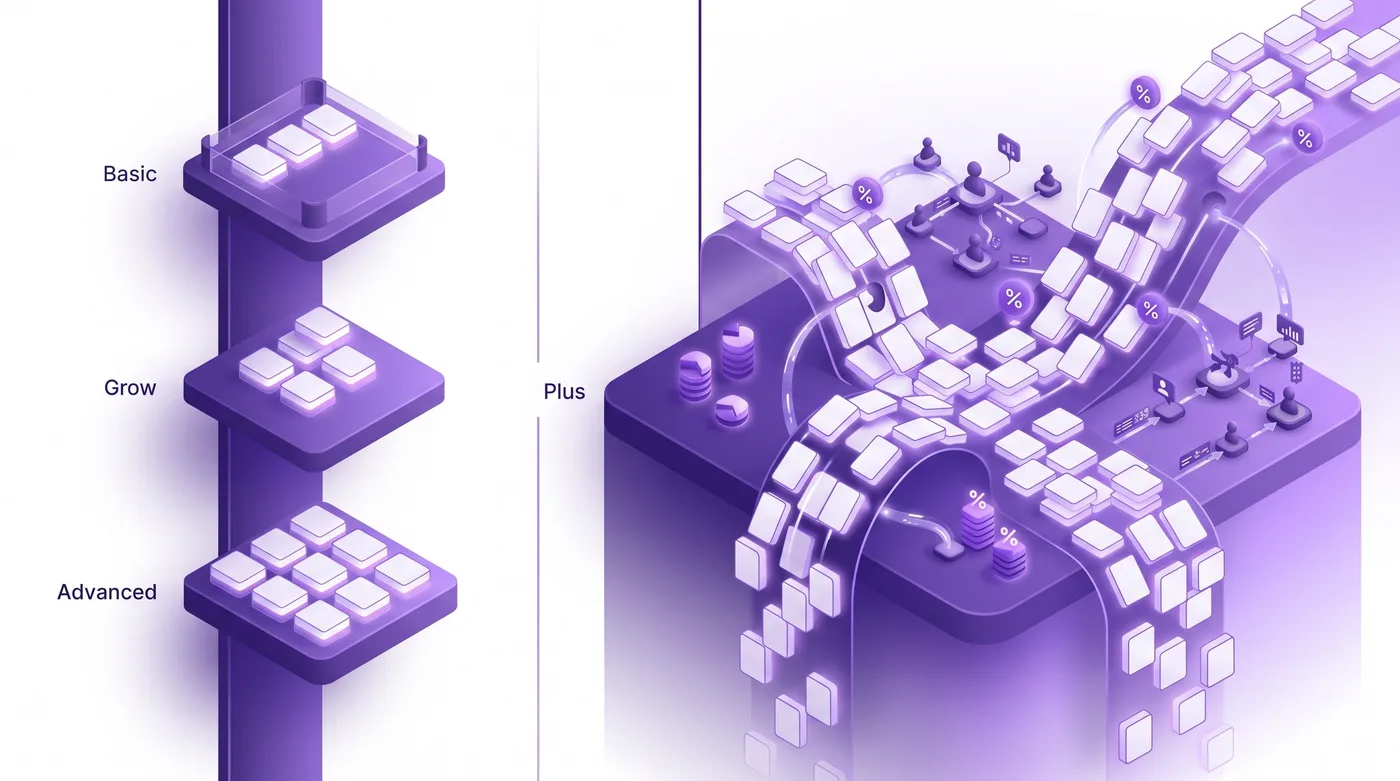
The April 2, 2026 rollout opened native B2B to every paid plan with a deliberately limited feature set — and the limits are exactly where high-volume wholesale operations break. Non-Plus stores get company profiles, payment terms, volume pricing, vaulted cards, ACH (US), and up to 3 catalogs via Markets. That covers tier-based pricing and small-to-mid wholesale. It doesn't cover serious scale.
The five Plus-exclusive differentiators that matter operationally:
Plus-only feature | Why it matters at scale |
|---|---|
Unlimited B2B catalogs | 500+ wholesale customers each with negotiated pricing means hundreds of catalogs |
Direct catalog-to-company/location assignment | Skip the Markets workaround; assign catalogs natively |
Partial payments | Deposit + balance billing for high-ticket orders, milestone payments |
Deposits | Required for custom orders, made-to-order goods, made-to-spec B2B |
Sales rep permission scoping | Reps see only assigned accounts; no cross-customer data leakage |
The 500-wholesale-customer threshold is roughly where non-Plus B2B becomes painful. Below it, the 3-catalog cap is workable through tier-based pricing. Above it, you're either inventing workarounds or accepting that some buyers get the wrong pricing — either failure mode costs more than the Plus jump.

The Plus B2B Architecture: Companies, Locations, Catalogs at Scale
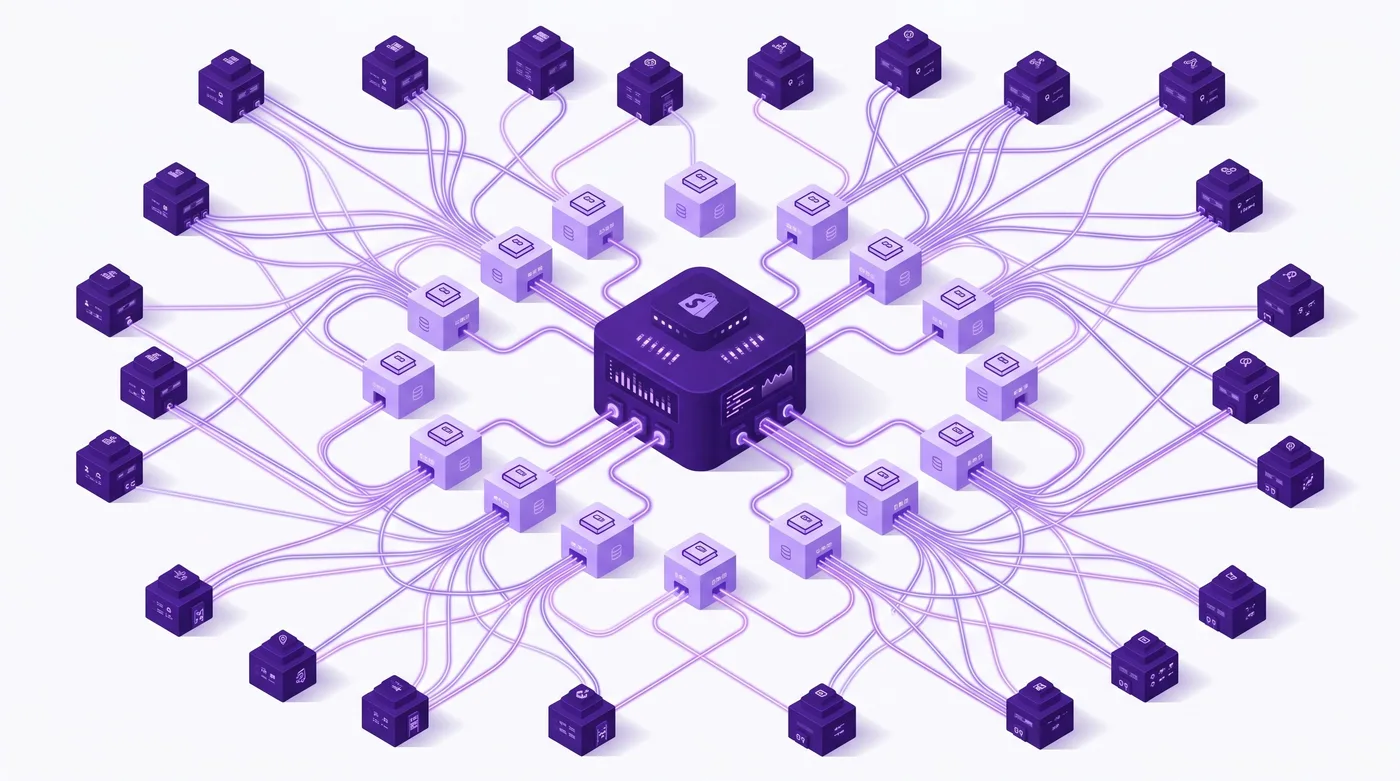
Plus B2B at 500+ wholesale customers is the same Company → Location → Buyer hierarchy, but the configuration density differentiates it from non-Plus. A non-Plus store might run 50 companies, 80 locations, 3 catalogs. A Plus operation runs 500 companies, 1,500 locations, and 250+ catalogs — and the Plus-exclusive direct-assignment model is what makes that survivable.
Non-Plus pattern: catalogs assigned to Markets, companies inherit catalog access via Market membership. Workable for 3 catalogs, breaks at 10+.
Plus pattern: catalogs assigned directly to specific companies or locations. A catalog can be unique to one company, shared across a group, or the default for many — your call.
For agency tech leads: when migrating from a third-party app or from non-Plus B2B to Plus, the catalog-assignment audit is the longest part of the project. Map every pricing rule to a Plus catalog, decide whether it's company-scoped or location-scoped, document the assignment logic before touching the platform.
Unlimited Catalogs: How Plus Operators Actually Use Them
The unlimited catalog ceiling lets you separate catalog purpose from catalog scope in ways the 3-catalog cap doesn't allow. Plus operations run catalogs across three dimensions: pricing tier, product line, and customer type.
Concrete patterns in production Plus B2B stores:
Per-customer negotiated pricing — Acme gets their own catalog, Beta Corp gets theirs. 500+ companies, 500+ catalogs.
Product-line overlays — a "seasonal release" catalog with new SKUs assigned to top 50 accounts; the rest see the standard catalog.
Region-specific pricing inside one Market — Markets handles currency and tax; catalogs handle per-customer regional variance Markets doesn't model.
Custom-order catalogs — separate catalog for made-to-spec products with deposit requirements, assigned only to pre-approved companies.
Volume pricing also improved in 2026: tier breakpoints can now apply at the variant level, so a t-shirt product can have different volume pricing per size within the same catalog.

Partial Payments and Deposits: The Cash Flow Layer
Partial payments and deposits are Plus-exclusive features that change the cash flow model for B2B operations doing custom, made-to-order, or high-ticket work. A non-Plus store collects upfront, ships on terms, or invoices outside Shopify. A Plus store can do all three plus deposit-and-balance.
Operational patterns:
Made-to-order: 50% deposit at order, 50% on shipment. Deposit secures production capacity.
High-ticket milestone billing: $50k order split 30/30/40 across order, production milestone, delivery.
Backordered SKUs: the February 6, 2026 payment-requests-per-fulfillment update extends the model to fulfillments — each shipment triggers the next payment request in the buyer's Customer Account.
Combined with Net 30/60/90 on the balance, you get a cash flow model that previously required custom AR or enterprise ERP integration. On Plus, it's native.
Sales Rep Workflows at Scale
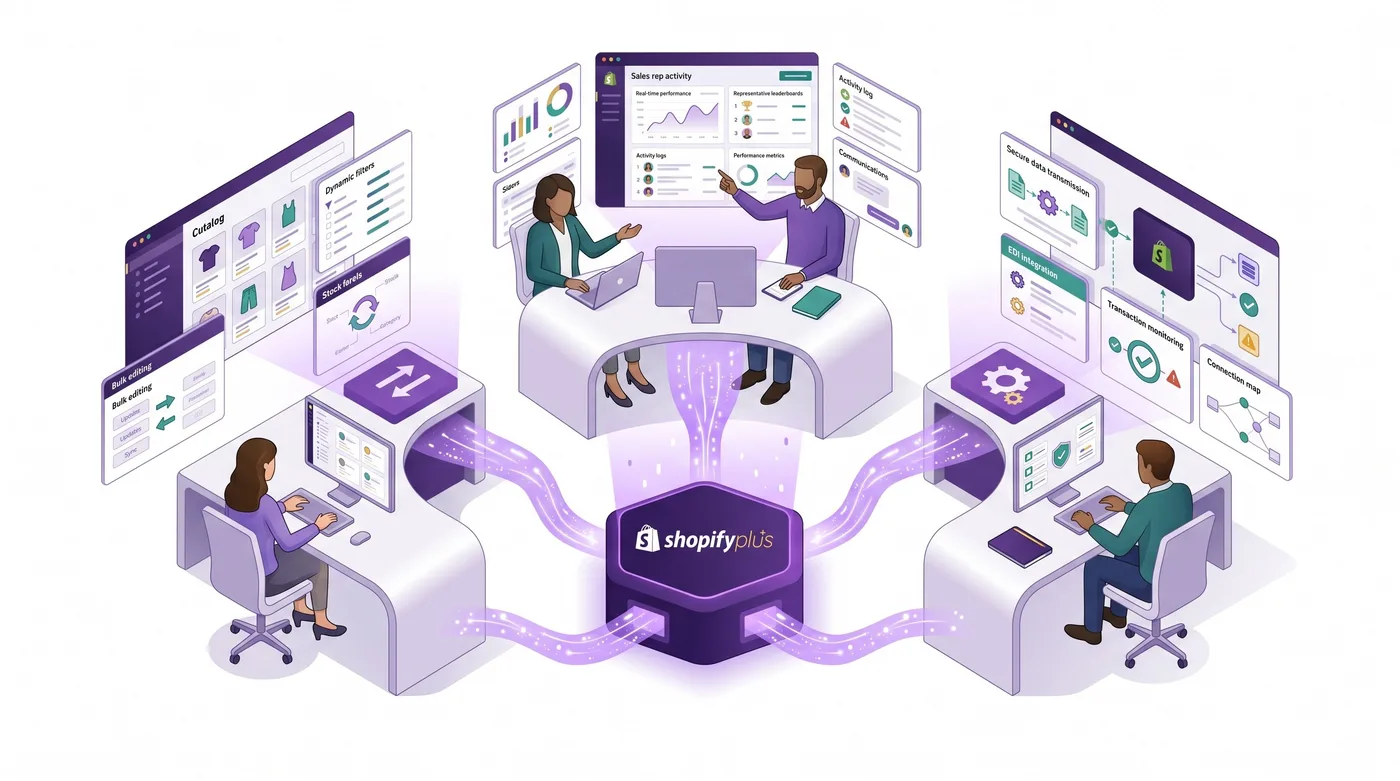
As of the Spring 2026 update, sales rep permissions can be scoped to specific company accounts — Plus-only — eliminating the most common B2B operational risk: reps seeing accounts they shouldn't. A scoped sales rep can create and edit draft orders only for assigned companies.
Plus B2B patterns this unlocks:
Geographic territory ownership — Rep A owns East Coast, Rep B owns West Coast, no cross-visibility
Account-tier specialization — top-50 enterprise to senior reps, mid-market to junior reps
Channel separation — direct B2B reps separate from distributor-channel reps
Agency rep access — your agency's account managers get scoped access to specific clients
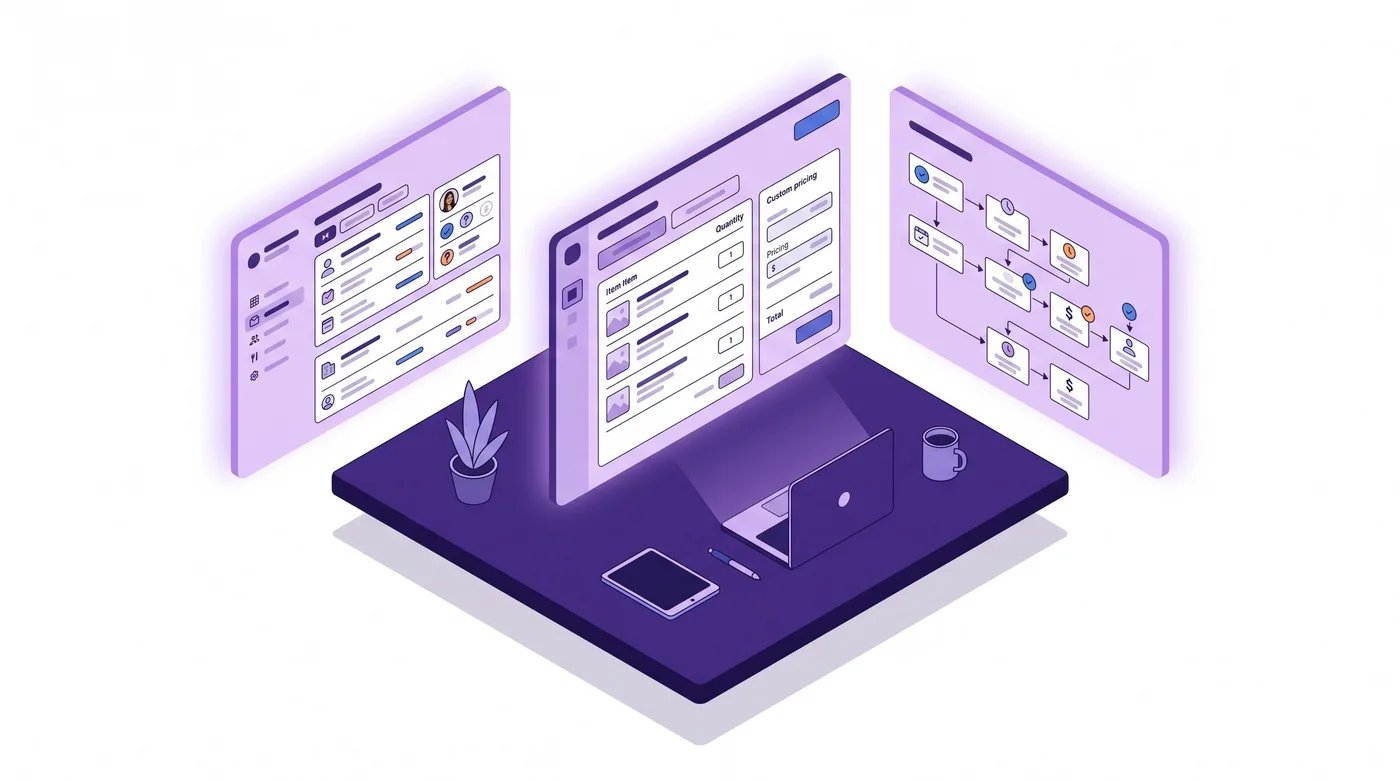
Combined with draft orders (the standard Plus pattern for negotiated quotes), scoped reps build complete proposals — line items, custom pricing, payment terms, shipping — without exposure to other accounts.
Headless B2B with the Storefront API
For Plus operators whose buyer experience requirements outgrow Trade or Horizon themes, the Storefront API exposes the full B2B object model — buyer auth, catalog-aware pricing, payment terms, draft orders — for fully custom portal builds. Crossover point is usually 500+ active wholesale buyer logins per month.
The headless B2B pattern in 2026:
Authentication via Storefront API — buyers log in through your portal; the API issues a buyer token scoped to their company location, determining catalog access and pricing.
Catalog-aware product queries — GraphQL queries return the right pricing for the authenticated buyer's location automatically.
Custom approval workflows — for multi-buyer companies with order thresholds, your portal handles approval routing; Admin API tracks resulting orders.
Deep ERP / AP integration — most enterprise B2B portals integrate with the buyer's procurement system (Coupa, Ariba, NetSuite); that integration sits on your custom portal, not Shopify.
The trade-off: full UI control and deep integration, but you own all maintenance. Trade and Horizon get Shopify-managed updates; your custom portal does not.
EDI Integration: SPS Commerce, Crstl, and Custom EDI
The Winter '26 EDI integration support means Plus B2B operations can sync purchase orders directly from SPS Commerce and Crstl as draft orders — replacing custom EDI middleware or manual order entry. For B2B operations selling into big-box retail or distributor networks, this is a meaningful operational change.
What the integration handles: POs received via EDI flow into Shopify as draft orders; approve, edit, ship from the admin; status messages flow back as fulfillments progress. Standard 850 (PO), 855 (PO acknowledgment), and 856 (ASN) documents are covered.
What it doesn't replace: the EDI partnership itself (you still need an SPS Commerce or Crstl account), trading partner certification, or non-standard EDI document types. For Plus operators selling into Walmart, Target, Costco, or major distributors, the SPS Commerce + Shopify path is now competitive with running a separate EDI/ERP stack alongside Shopify.
B2B-Specific Flow Patterns for Plus
Flow's December 2025 test runs and ongoing trigger expansion turned it into a production automation layer for Plus B2B — and B2B-specific patterns are different from DTC. Plus operators should not be running B2B on the same Flow workflows as DTC.
High-impact B2B Flow patterns for 2026:
Auto-route by company tier. Trigger:
Order created. Condition: company tag = "enterprise". Action: assign to dedicated fulfillment, tag for priority, notify account manager.Payment terms expiration alerts. Trigger: scheduled. Condition: Net-30 order, 25+ days old. Action: notify AR team, tag for collection follow-up.
Sales rep notifications on edits. Trigger:
Order updated. Condition: order belongs to assigned company. Action: notify the rep via Slack.Auto-approval thresholds. Trigger:
Draft order created. Condition: total > $X for company tier Y. Action: route to admin review, send approval request.EDI status sync-back. Trigger:
Fulfillment created. Condition: source = EDI. Action: trigger 856 (ASN) generation.
Payment Customization Functions pairs naturally — flag B2B orders for admin review based on value, product, or customer attributes, with routing logic in a deployed Function.
Multi-Store and Multi-Market B2B
Plus operators running multi-store organizations or B2B across multiple Markets get 2026 capabilities that materially change the international wholesale architecture. The March 13, 2026 update — per-Market theme settings and app embeds — let you customize the storefront experience per Market without running a separate store per region.
The Plus multi-store / multi-market B2B pattern in 2026:
One Plus organization, multiple stores — each region-specific (US, EU, APAC) with its own product catalog, currency, and tax rules, but company accounts unified at the org level.
Markets within a store for finer-grained regions — sub-regional catalogs and per-Market theme customizations let you serve French and German B2B buyers from one EU store with different storefront configurations.
Per-Market app embeds — different B2B apps per market (EDI in US, different in EU), auto-loaded based on the buyer's Market.
For agencies onboarding multi-region wholesale clients, this is the architectural shift to lead with: multi-region B2B used to mean multi-store. In 2026, much of that complexity collapses into one store with proper Markets configuration.
Post-Purchase Order Editing for B2B at Scale
B2B orders need editing more often than DTC orders, and at Plus scale that volume becomes an operational ceiling — net-30 invoices to the wrong AP contact, addresses typed wrong on phone orders, quantities shifting, PO numbers coming back days later. A busy Plus B2B operation can lose 5-15 hours of ops time per week to routine post-purchase changes.
Native Shopify B2B handles merchant-side edits through the admin. What it doesn't provide is self-service editing for the buyer.
Since this is the Revize blog: Revize supports B2B order editing including address changes on orders with payment terms, quantity adjustments before fulfillment, and more. At 1,000 B2B orders/month with 8% generating change requests, that's 80+ tickets/month routed to self-service. For deeper operations context, see our Shopify Order Management Guide 2026.
The Bottom Line
Shopify Plus B2B in 2026 is a scale story, not an access story. The April 2 rollout opened B2B fundamentals to every paid plan; what Plus delivers is the architecture that holds up at 500+ wholesale customers, multi-store organizations, headless portals, and EDI-integrated retail relationships.
For Plus operators currently running B2B: audit your catalog-assignment patterns. If you migrated from a 2023-era price list setup, you may be missing per-variant volume pricing and per-Market theme customization. Test-run B2B Flow workflows you haven't touched in 6 months.
For agencies onboarding wholesale clients: the discovery question is no longer "do they need Plus" — it's "where on the scale curve are they, and what's the 12-month trajectory?" A client at 100 wholesale customers may not need Plus today; if they're growing 15% per quarter, they will in 18 months.
For everyone: native Plus B2B still doesn't provide buyer-facing self-service order editing. That gap is the single highest-impact missing piece in most Plus B2B stacks.
Here's what to do this week:
Audit your catalog assignments — per-customer where they should be, or stuck on Markets workarounds?
Review sales rep permissions — scoped, or still seeing the full book?
Evaluate whether partial payments / deposits would unlock business you've been turning away
Test-run any B2B Flow workflows you haven't touched in 6+ months
If you don't have buyer-facing self-service order editing, install one — the support-hours math is unambiguous at Plus B2B volume

Frequently Asked Questions
Do I need Shopify Plus to run B2B in 2026?
No — as of April 2, 2026, foundational B2B is on every paid plan. Basic, Grow, and Advanced get company profiles, payment terms, volume pricing, vaulted cards, ACH (US), and up to 3 catalogs. You need Plus when you outgrow those — usually 500+ wholesale customers, when you need partial payments or deposits, or sales rep permission scoping.
What's the practical difference between non-Plus and Plus B2B?
The 3-catalog cap is the most-felt limit, but partial payments, deposits, direct catalog assignment, and sales rep scoping are the differentiators that compound at scale. Non-Plus B2B handles tier-based pricing cleanly. Plus handles negotiated per-customer pricing, milestone billing, and territory-based sales rep workflows.
How many catalogs do typical Plus B2B operations run?
Plus operations running 500+ wholesale customers typically run 50-300+ active catalogs depending on whether pricing is negotiated per-customer or grouped by tier. Tier-based models survive on a handful of catalogs at any volume. Negotiated-per-customer models need roughly one catalog per customer or group — which is why unlimited matters.
When should I move from Trade theme to a headless B2B portal?
Start with Trade or Horizon and consider headless when buyer logins exceed ~500/month or experience requirements outgrow themes. Headless gives total UI control and deep ERP/procurement integration; you own all the maintenance.
How do partial payments and deposits work?
Plus-exclusive — collect a deposit at order and the balance later, or split payment across milestones. The buyer pays through Customer Accounts as each scheduled payment comes due. Common patterns: 50/50 made-to-order; 30/30/40 milestone-billed; deposit + net-30 balance.
Can sales reps see only their assigned customers?
Yes — Spring 2026 added staff permission scoping for specific company accounts. A scoped rep can create and edit draft orders only for assigned companies. Plus-exclusive. Unlocks territory ownership, account-tier specialization, and channel separation safely.
Does Shopify B2B work with EDI?
Yes — Winter '26 added integrated EDI support via SPS Commerce and Crstl, with POs flowing into Shopify as draft orders. Approve, edit, ship from the admin; status flows back as fulfillments progress. Standard 850/855/856 documents covered.
How does Plus B2B handle multi-region wholesale?
Plus operators run multi-region B2B through Markets within one store, with per-Market theme customization (March 13, 2026) handling storefront variation. This collapses what was multi-store complexity into one store with proper Markets configuration.
Can I run B2B and DTC on the same Plus store?
Yes — same store, same admin, same product catalog, same checkout codebase. B2B buyers see company-scoped catalog, payment terms, and PO number field; DTC buyers see public retail and consumer payment methods. Same fulfillment, same inventory pool.
What's new for Plus B2B in 2026?
B2B-on-all-plans (April 2), per-Market theme settings (March 13), Sidekick AI for B2B, EDI integration, store credit for company locations, B2B-ready Horizon themes, sales rep scoping, and Payment Customization Functions for order review. All except the first are Plus-relevant features that materially affect Plus B2B architecture.
Can buyers self-serve order edits on B2B orders?
Native Plus B2B doesn't provide buyer-facing post-purchase editing — buyers contact the merchant for changes. This is the gap most Plus teams notice at scale: quantity adjustments, address corrections, PO updates all become tickets. Apps like Revize add self-service editing including orders on payment terms.
What's the migration timeline from a third-party wholesale app?
4-8 weeks for 50-200 wholesale customers, longer for 500+ with deeply negotiated pricing. The bottleneck is data reconciliation — duplicate companies, split locations, pricing exceptions in custom fields — not platform setup. Budget more time for catalog-assignment auditing than for Shopify configuration.
Related Articles
Shopify Order Management 2026: Plus Operator's Architecture Playbook — operations layer Plus B2B runs on
Shopify Checkout Extensibility 2026 — checkout layer Shopify Plus B2B uses
How to Edit an Order on Shopify — order editing fundamentals
Advanced Shopify Flow Workflows — automation patterns for the architecture above
The Universal Commerce Protocol (UCP) — broader Shopify direction
Shopify Plus B2B 2026 — what scaling wholesale operators need to know in 15 seconds
Plus B2B is no longer about access — it's about scale. Since April 2, 2026, every paid plan gets the foundational B2B features. Plus's value sits where non-Plus stores hit ceilings.
Five Plus-only differentiators matter at scale: unlimited catalogs, direct catalog-to-company/location assignment, partial payments, deposits, and sales rep permission scoping.
The 500-wholesale-customer line is the real threshold. Below it, non-Plus B2B usually works. Above it, the 3-catalog cap, lack of partial payments, and sales-rep gaps become operational blockers.
What's new for Plus B2B in 2026: per-Market theme customization (March 13), EDI integration with SPS Commerce and Crstl, Sidekick AI for B2B company creation, store credit for company locations.
The unsexy reality: post-purchase order editing — quantity edits on net-30 orders, address splits, PO corrections — is still the workflow where Plus B2B ops teams lose the most hours per week.
Shopify Plus B2B in 2026 is what you adopt when non-Plus B2B stops being enough. The April 2, 2026 rollout of foundational B2B to Basic, Grow, and Advanced changed the question from "can we run wholesale on Shopify?" to "at what scale do we need Plus?" For high-volume operators, agencies onboarding enterprise wholesale clients, and devs building headless buyer portals, the answer is in the differentiators — not the basics.
This guide is for the people running B2B on Plus today, evaluating Plus for an operation that's outgrown its current setup, or architecting a B2B implementation for a client whose volume crosses into Plus territory.

Why Plus B2B Still Matters After the April 2 Rollout
The April 2, 2026 rollout opened native B2B to every paid plan with a deliberately limited feature set — and the limits are exactly where high-volume wholesale operations break. Non-Plus stores get company profiles, payment terms, volume pricing, vaulted cards, ACH (US), and up to 3 catalogs via Markets. That covers tier-based pricing and small-to-mid wholesale. It doesn't cover serious scale.
The five Plus-exclusive differentiators that matter operationally:
Plus-only feature | Why it matters at scale |
|---|---|
Unlimited B2B catalogs | 500+ wholesale customers each with negotiated pricing means hundreds of catalogs |
Direct catalog-to-company/location assignment | Skip the Markets workaround; assign catalogs natively |
Partial payments | Deposit + balance billing for high-ticket orders, milestone payments |
Deposits | Required for custom orders, made-to-order goods, made-to-spec B2B |
Sales rep permission scoping | Reps see only assigned accounts; no cross-customer data leakage |
The 500-wholesale-customer threshold is roughly where non-Plus B2B becomes painful. Below it, the 3-catalog cap is workable through tier-based pricing. Above it, you're either inventing workarounds or accepting that some buyers get the wrong pricing — either failure mode costs more than the Plus jump.

The Plus B2B Architecture: Companies, Locations, Catalogs at Scale
Plus B2B at 500+ wholesale customers is the same Company → Location → Buyer hierarchy, but the configuration density differentiates it from non-Plus. A non-Plus store might run 50 companies, 80 locations, 3 catalogs. A Plus operation runs 500 companies, 1,500 locations, and 250+ catalogs — and the Plus-exclusive direct-assignment model is what makes that survivable.
Non-Plus pattern: catalogs assigned to Markets, companies inherit catalog access via Market membership. Workable for 3 catalogs, breaks at 10+.
Plus pattern: catalogs assigned directly to specific companies or locations. A catalog can be unique to one company, shared across a group, or the default for many — your call.
For agency tech leads: when migrating from a third-party app or from non-Plus B2B to Plus, the catalog-assignment audit is the longest part of the project. Map every pricing rule to a Plus catalog, decide whether it's company-scoped or location-scoped, document the assignment logic before touching the platform.
Unlimited Catalogs: How Plus Operators Actually Use Them
The unlimited catalog ceiling lets you separate catalog purpose from catalog scope in ways the 3-catalog cap doesn't allow. Plus operations run catalogs across three dimensions: pricing tier, product line, and customer type.
Concrete patterns in production Plus B2B stores:
Per-customer negotiated pricing — Acme gets their own catalog, Beta Corp gets theirs. 500+ companies, 500+ catalogs.
Product-line overlays — a "seasonal release" catalog with new SKUs assigned to top 50 accounts; the rest see the standard catalog.
Region-specific pricing inside one Market — Markets handles currency and tax; catalogs handle per-customer regional variance Markets doesn't model.
Custom-order catalogs — separate catalog for made-to-spec products with deposit requirements, assigned only to pre-approved companies.
Volume pricing also improved in 2026: tier breakpoints can now apply at the variant level, so a t-shirt product can have different volume pricing per size within the same catalog.

Partial Payments and Deposits: The Cash Flow Layer
Partial payments and deposits are Plus-exclusive features that change the cash flow model for B2B operations doing custom, made-to-order, or high-ticket work. A non-Plus store collects upfront, ships on terms, or invoices outside Shopify. A Plus store can do all three plus deposit-and-balance.
Operational patterns:
Made-to-order: 50% deposit at order, 50% on shipment. Deposit secures production capacity.
High-ticket milestone billing: $50k order split 30/30/40 across order, production milestone, delivery.
Backordered SKUs: the February 6, 2026 payment-requests-per-fulfillment update extends the model to fulfillments — each shipment triggers the next payment request in the buyer's Customer Account.
Combined with Net 30/60/90 on the balance, you get a cash flow model that previously required custom AR or enterprise ERP integration. On Plus, it's native.
Sales Rep Workflows at Scale
As of the Spring 2026 update, sales rep permissions can be scoped to specific company accounts — Plus-only — eliminating the most common B2B operational risk: reps seeing accounts they shouldn't. A scoped sales rep can create and edit draft orders only for assigned companies.
Plus B2B patterns this unlocks:
Geographic territory ownership — Rep A owns East Coast, Rep B owns West Coast, no cross-visibility
Account-tier specialization — top-50 enterprise to senior reps, mid-market to junior reps
Channel separation — direct B2B reps separate from distributor-channel reps
Agency rep access — your agency's account managers get scoped access to specific clients
Combined with draft orders (the standard Plus pattern for negotiated quotes), scoped reps build complete proposals — line items, custom pricing, payment terms, shipping — without exposure to other accounts.
Headless B2B with the Storefront API
For Plus operators whose buyer experience requirements outgrow Trade or Horizon themes, the Storefront API exposes the full B2B object model — buyer auth, catalog-aware pricing, payment terms, draft orders — for fully custom portal builds. Crossover point is usually 500+ active wholesale buyer logins per month.
The headless B2B pattern in 2026:
Authentication via Storefront API — buyers log in through your portal; the API issues a buyer token scoped to their company location, determining catalog access and pricing.
Catalog-aware product queries — GraphQL queries return the right pricing for the authenticated buyer's location automatically.
Custom approval workflows — for multi-buyer companies with order thresholds, your portal handles approval routing; Admin API tracks resulting orders.
Deep ERP / AP integration — most enterprise B2B portals integrate with the buyer's procurement system (Coupa, Ariba, NetSuite); that integration sits on your custom portal, not Shopify.
The trade-off: full UI control and deep integration, but you own all maintenance. Trade and Horizon get Shopify-managed updates; your custom portal does not.
EDI Integration: SPS Commerce, Crstl, and Custom EDI
The Winter '26 EDI integration support means Plus B2B operations can sync purchase orders directly from SPS Commerce and Crstl as draft orders — replacing custom EDI middleware or manual order entry. For B2B operations selling into big-box retail or distributor networks, this is a meaningful operational change.
What the integration handles: POs received via EDI flow into Shopify as draft orders; approve, edit, ship from the admin; status messages flow back as fulfillments progress. Standard 850 (PO), 855 (PO acknowledgment), and 856 (ASN) documents are covered.
What it doesn't replace: the EDI partnership itself (you still need an SPS Commerce or Crstl account), trading partner certification, or non-standard EDI document types. For Plus operators selling into Walmart, Target, Costco, or major distributors, the SPS Commerce + Shopify path is now competitive with running a separate EDI/ERP stack alongside Shopify.
B2B-Specific Flow Patterns for Plus
Flow's December 2025 test runs and ongoing trigger expansion turned it into a production automation layer for Plus B2B — and B2B-specific patterns are different from DTC. Plus operators should not be running B2B on the same Flow workflows as DTC.
High-impact B2B Flow patterns for 2026:
Auto-route by company tier. Trigger:
Order created. Condition: company tag = "enterprise". Action: assign to dedicated fulfillment, tag for priority, notify account manager.Payment terms expiration alerts. Trigger: scheduled. Condition: Net-30 order, 25+ days old. Action: notify AR team, tag for collection follow-up.
Sales rep notifications on edits. Trigger:
Order updated. Condition: order belongs to assigned company. Action: notify the rep via Slack.Auto-approval thresholds. Trigger:
Draft order created. Condition: total > $X for company tier Y. Action: route to admin review, send approval request.EDI status sync-back. Trigger:
Fulfillment created. Condition: source = EDI. Action: trigger 856 (ASN) generation.
Payment Customization Functions pairs naturally — flag B2B orders for admin review based on value, product, or customer attributes, with routing logic in a deployed Function.

Multi-Store and Multi-Market B2B
Plus operators running multi-store organizations or B2B across multiple Markets get 2026 capabilities that materially change the international wholesale architecture. The March 13, 2026 update — per-Market theme settings and app embeds — let you customize the storefront experience per Market without running a separate store per region.
The Plus multi-store / multi-market B2B pattern in 2026:
One Plus organization, multiple stores — each region-specific (US, EU, APAC) with its own product catalog, currency, and tax rules, but company accounts unified at the org level.
Markets within a store for finer-grained regions — sub-regional catalogs and per-Market theme customizations let you serve French and German B2B buyers from one EU store with different storefront configurations.
Per-Market app embeds — different B2B apps per market (EDI in US, different in EU), auto-loaded based on the buyer's Market.
For agencies onboarding multi-region wholesale clients, this is the architectural shift to lead with: multi-region B2B used to mean multi-store. In 2026, much of that complexity collapses into one store with proper Markets configuration.
Post-Purchase Order Editing for B2B at Scale
B2B orders need editing more often than DTC orders, and at Plus scale that volume becomes an operational ceiling — net-30 invoices to the wrong AP contact, addresses typed wrong on phone orders, quantities shifting, PO numbers coming back days later. A busy Plus B2B operation can lose 5-15 hours of ops time per week to routine post-purchase changes.
Native Shopify B2B handles merchant-side edits through the admin. What it doesn't provide is self-service editing for the buyer.
Since this is the Revize blog: Revize supports B2B order editing including address changes on orders with payment terms, quantity adjustments before fulfillment, and more. At 1,000 B2B orders/month with 8% generating change requests, that's 80+ tickets/month routed to self-service. For deeper operations context, see our Shopify Order Management Guide 2026.
The Bottom Line
Shopify Plus B2B in 2026 is a scale story, not an access story. The April 2 rollout opened B2B fundamentals to every paid plan; what Plus delivers is the architecture that holds up at 500+ wholesale customers, multi-store organizations, headless portals, and EDI-integrated retail relationships.
For Plus operators currently running B2B: audit your catalog-assignment patterns. If you migrated from a 2023-era price list setup, you may be missing per-variant volume pricing and per-Market theme customization. Test-run B2B Flow workflows you haven't touched in 6 months.
For agencies onboarding wholesale clients: the discovery question is no longer "do they need Plus" — it's "where on the scale curve are they, and what's the 12-month trajectory?" A client at 100 wholesale customers may not need Plus today; if they're growing 15% per quarter, they will in 18 months.
For everyone: native Plus B2B still doesn't provide buyer-facing self-service order editing. That gap is the single highest-impact missing piece in most Plus B2B stacks.
Here's what to do this week:
Audit your catalog assignments — per-customer where they should be, or stuck on Markets workarounds?
Review sales rep permissions — scoped, or still seeing the full book?
Evaluate whether partial payments / deposits would unlock business you've been turning away
Test-run any B2B Flow workflows you haven't touched in 6+ months
If you don't have buyer-facing self-service order editing, install one — the support-hours math is unambiguous at Plus B2B volume

Frequently Asked Questions
Do I need Shopify Plus to run B2B in 2026?
No — as of April 2, 2026, foundational B2B is on every paid plan. Basic, Grow, and Advanced get company profiles, payment terms, volume pricing, vaulted cards, ACH (US), and up to 3 catalogs. You need Plus when you outgrow those — usually 500+ wholesale customers, when you need partial payments or deposits, or sales rep permission scoping.
What's the practical difference between non-Plus and Plus B2B?
The 3-catalog cap is the most-felt limit, but partial payments, deposits, direct catalog assignment, and sales rep scoping are the differentiators that compound at scale. Non-Plus B2B handles tier-based pricing cleanly. Plus handles negotiated per-customer pricing, milestone billing, and territory-based sales rep workflows.
How many catalogs do typical Plus B2B operations run?
Plus operations running 500+ wholesale customers typically run 50-300+ active catalogs depending on whether pricing is negotiated per-customer or grouped by tier. Tier-based models survive on a handful of catalogs at any volume. Negotiated-per-customer models need roughly one catalog per customer or group — which is why unlimited matters.
When should I move from Trade theme to a headless B2B portal?
Start with Trade or Horizon and consider headless when buyer logins exceed ~500/month or experience requirements outgrow themes. Headless gives total UI control and deep ERP/procurement integration; you own all the maintenance.
How do partial payments and deposits work?
Plus-exclusive — collect a deposit at order and the balance later, or split payment across milestones. The buyer pays through Customer Accounts as each scheduled payment comes due. Common patterns: 50/50 made-to-order; 30/30/40 milestone-billed; deposit + net-30 balance.
Can sales reps see only their assigned customers?
Yes — Spring 2026 added staff permission scoping for specific company accounts. A scoped rep can create and edit draft orders only for assigned companies. Plus-exclusive. Unlocks territory ownership, account-tier specialization, and channel separation safely.
Does Shopify B2B work with EDI?
Yes — Winter '26 added integrated EDI support via SPS Commerce and Crstl, with POs flowing into Shopify as draft orders. Approve, edit, ship from the admin; status flows back as fulfillments progress. Standard 850/855/856 documents covered.
How does Plus B2B handle multi-region wholesale?
Plus operators run multi-region B2B through Markets within one store, with per-Market theme customization (March 13, 2026) handling storefront variation. This collapses what was multi-store complexity into one store with proper Markets configuration.
Can I run B2B and DTC on the same Plus store?
Yes — same store, same admin, same product catalog, same checkout codebase. B2B buyers see company-scoped catalog, payment terms, and PO number field; DTC buyers see public retail and consumer payment methods. Same fulfillment, same inventory pool.
What's new for Plus B2B in 2026?
B2B-on-all-plans (April 2), per-Market theme settings (March 13), Sidekick AI for B2B, EDI integration, store credit for company locations, B2B-ready Horizon themes, sales rep scoping, and Payment Customization Functions for order review. All except the first are Plus-relevant features that materially affect Plus B2B architecture.
Can buyers self-serve order edits on B2B orders?
Native Plus B2B doesn't provide buyer-facing post-purchase editing — buyers contact the merchant for changes. This is the gap most Plus teams notice at scale: quantity adjustments, address corrections, PO updates all become tickets. Apps like Revize add self-service editing including orders on payment terms.
What's the migration timeline from a third-party wholesale app?
4-8 weeks for 50-200 wholesale customers, longer for 500+ with deeply negotiated pricing. The bottleneck is data reconciliation — duplicate companies, split locations, pricing exceptions in custom fields — not platform setup. Budget more time for catalog-assignment auditing than for Shopify configuration.
Related Articles
Shopify Order Management 2026: Plus Operator's Architecture Playbook — operations layer Plus B2B runs on
Shopify Checkout Extensibility 2026 — checkout layer Shopify Plus B2B uses
How to Edit an Order on Shopify — order editing fundamentals
Advanced Shopify Flow Workflows — automation patterns for the architecture above
The Universal Commerce Protocol (UCP) — broader Shopify direction
Revize your Shopify store, and lead with
customer experience
© Copyright 2024, All Rights Reserved
Revize your Shopify store, and lead with
customer experience
© Copyright 2024, All Rights Reserved
Revize your Shopify store, and lead with
customer experience
© Copyright 2024, All Rights Reserved
Revize your Shopify store, and lead with
customer experience
© Copyright 2024, All Rights Reserved